Sustainable Development Policy and Structure
The management structure of the SCG Sustainable Development Committee has been established in order to align and integrate management of sustainability into core business strategy and plan. As a result, the governance structure comprises three dimensions, Social Dimension, Environmental Dimension, and Economic Dimension. The core committees or working groups will regularly meet on a quarterly basis.
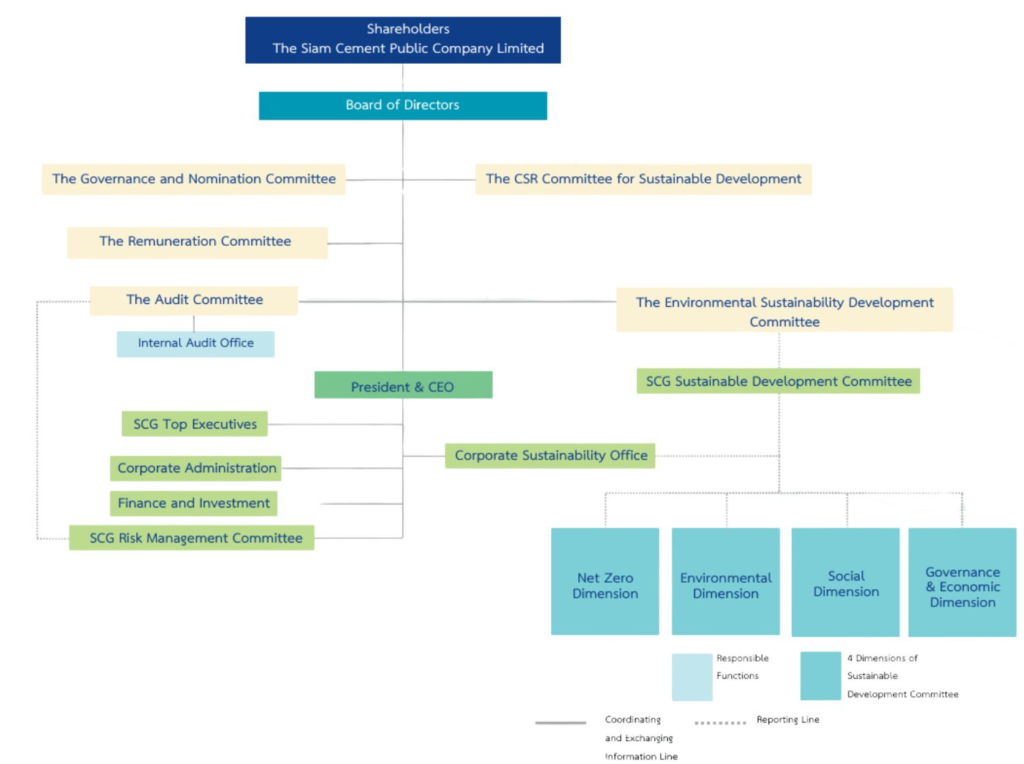
The core committees or working groups relating to sustainable development are as follow;
Environmental Sustainability Development Committee
- Establish directions, policies, and strategies to drive SCG towards its goals; consider and provide recommendations to ensure the implementation of the SCG Net Zero Roadmap in order to bring about organizational transformation at all levels and ensure that policies are comprehensively implemented and connected to all company activities and that key issues regarding both risks and opportunities involved in a transition to a green and sustainable economy are integrated into core business strategies.
- Review and supervise GHG reduction investment plans and evaluate the performance of major projects using internationally recognized tools, such as the Marginal Abatement Cost Curve (MACC) and Internal Carbon Pricing (ICP), to support decisions that align with the Company’s decarbonization targets and enhance competitiveness both in the short and long term.
- Supervise, monitor, and review policies, plans, goals, and performance according to the SCG Net Zero Roadmap to ensure efficiency and effectiveness in reducing greenhouse gas emissions; put in place an accurate, transparent, and verifiable data system that complies with international standards for measurement, reporting, and verification.
The CSR Committee for Sustainable Development
- Emphasizing environmental balance and the transition to a low-carbon society by restoring and conserving natural resources, strengthening communities, and improving quality of life. This is achieved through collaboration among the public sector, private sector, and civil society under the Inclusive Green Growth framework, which advances climate action while ensuring balanced, inclusive, and sustainable social and environmental development.
- 2025 performance and 2026 action plans for CSR projects and activities related to key ESG issues, namely climate crisis, nature crisis, and mounting inequality
- Driving ESG projects through three principles: multilateralism, multigene rationalism, and multidisciplinary
SCG Risk Management Committee
- Key risks: Climate change, health and safety, human rights
- Emerging risks: Rapid and severe changes in the business landscape, low-carbon economy, inefficient plastic waste management, and cyberthreats
SCG Sustainable Development Committee
- Management of ESG issues across the value chain for practical implementation and change leadership
- Review of materiality and integration into business strategies
- Engagement of national and international stakeholders, such as WBCSD, UNGC, Ellen MacArthur Foundation, TBCSD, the Federation of Thai Industries, The Thai Chamber of Commerce and Board of Trade of Thailand and government agencies
Net Zero Dimension
- GHG emissions inventory and reporting across the value chain
- Establishing GHG reduction targets in accordance with science-based targets (SBT) and the Paris Agreement
- Business risk and opportunity assessment according to an international framework (TCFD)
Environmental Dimension
- Climate change and energy, eco-efficiency, and biodiversity and ecosystem
- Circular economy, product stewardship, waste management, water management, and air quality management
- Formulation of strategies and plans, development of products, services, and solutions in accordance with the principles of circular economy
- Fostering national and international collaborations
Social Dimension
- Promotion of the health and safety of employees and contractors
- Human rights and diversity and inclusion
- Reduce Inequality
Governance Dimension
- Corporate governance, enterprise risk management, business ethics, supply chain management, and disclosure and transparency
- Adaptations of businesses, strategies, investments, and activities in pursuit of a low-carbon economy and a transition towards target of net zero greenhouse gas (GHG) emissions
DOCUMENT DOWNLOAD