Inclusive Society
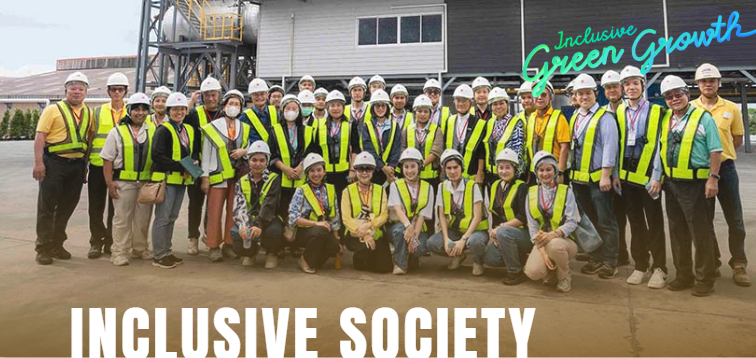
SCG is actively driving business growth in tandem with social development under the “Inclusive Green Growth” approach aiming to move business while fostering the creation of a balanced, inclusive, and resilient society. The Company recognizes that the transition to Net Zero cannot rely solely on technology or emission reduction measures, it requires building societal readiness, ensuring equitable access to opportunities and strengthening adaptability of all sectors for a just transition.
Guided by this vision, SCG has established the “Inclusive Society – Growing Together for Sustainability” strategy to elevate profitable growth toward responsible growth, built on a foundation of human rights to mitigating risks and prevent human rights violation, Governance of health and safety to ensure that employees, contractors, and third parties are free from work-related injuries and illnesses, while enhancing quality of life, and the empowerment of our employees, communities, business partners, and stakeholders across the entire value chain. The goal is to build a society where all sectors can participate in and benefit from the transition to a low-carbon economy in an equitable manner, forming the foundation for long-term competitiveness and sustainable growth. To drive this strategy, SCG employs four primary mechanisms:
1. Comprehensive policies and governance on labor, human rights, and supply chain management
2. Capability building for stakeholders throughout the value chain
3. Multi-sector partnerships to drive sustainable systemic impact
4. Data-driven reporting, analytics and monitoring for strategic decision-making
Operational Strategies
| Strategy | Key Actions |
| 1) Responsible Business Conduct Promoting human rights, health and safety, while striving to enhance quality of life. | • Govern, drive, and monitor human rights, health and safety execution through the Social Excellence Committee, and report progress to the SCG Sustainable Development Committee. • Establish policies, frameworks, standards, guidelines, targets, and strategies on human rights, health and safety to serve as guidance for driving concrete implementation. • Continuously manage human rights, health and safety risks, and establish mitigation and preventive measures for key risks, including leveraging digital technology and AI to enhance workplace safety. • Communicate and provide training to raise awareness and enhance understanding for effective implementation and integrating into Ethics e-Testing. • Enhance and expand leave benefits to better address the diverse needs of employees, and promote holistic well-being across four dimensions—physical, mental, financial, and social—through education, counseling, knowledge sharing, and other engagement activities. |
| 2) Employee Capability Development Developing essential skills required to navigate the transition toward a low-carbon and digital society. | • Integrate ESG knowledge and practical examples into SCG Flagship Programs throughout the employee journey. • Develop ESG training programs, including upskilling personnel in digital literacy, innovation, and green skills. • Expand learning and growth opportunities by providing platforms for employees to develop innovative products, services, and solutions that meet customer needs and create social value. |
| 3) Strengthening Resilience and Responsibility Across the Supply Chain Elevating labor, human rights, health and safety standards and supporting suppliers in their transition toward sustainability. | • levate labor, human rights, and health and safety standards for suppliers and contractors. • Promote transparent and fair management systems. • Support suppliers and contractors in enhancing their competitiveness through waste reduction and other decarbonization initiatives. • Build a business ecosystem based on transparency, fairness, and mutual growth. |
| 4) Fostering Strong and Resilient Communities Building community resilience against economic, social, and environmental shifts to achieve growth alongside the organization. | • Improve the quality of life for communities surrounding SCG’s plants and operations. • Provide knowledge, vocational training, and income-generating opportunities for local communities. • Enhance community resilience against economic, social, and climate-related changes. |
Outcomes
SCG is committed to enhancing the quality of life of employees, supply chain partners, communities, and society through strong governance in human rights, health and safety, and future skills development. The Company has established clear governance structures to oversee, drive, and monitor performance across these key areas as follows:
Employees
- Human rights management Overseen by the Human Rights and Stakeholder Engagement Committee, ensuring enterprise-wide compliance with international standards across both domestic and international operations. Human rights due diligence processes are conducted annually to proactively identify and mitigate potential risks that may impact the Company’s reputation and operating costs. In addition, grievance mechanisms and appropriate remediation measures are established to address potential impacts effectively and fairly.
- Health and safety Enhance safety management system through the Workplace Safety Committee and Transportation Safety Committee under the SCG Safety Framework, the Goods Transportation Safety Standard, and the “Life-Saving Rules,” covering both operations and transportation. Digital technologies are leveraged to improve effectiveness, such as the Health Management System for systematic employee health care, the Logistics Control Center and LMS to monitor transportation and ADAS/DMS to provide alerts and reduce risky driving behaviors. In addition, a Safety Dashboard is implemented to track safety performance in real time, fostering a proactive safety culture.
- Employee Capability Development and Skill Acceleration By embedding ESG concepts into the Employee Journey to ensure the readiness for the low carbon transition and evolving stringent environmental regulations. Capability development is delivered through SCG Flagship Programs, including the Net Zero Accelerator Program (NZP) for executives and the ESG Leadership Program for mid-level management, which cultivates sustainability-driven leadership, ensuring business decisions align with a low-carbon pathway. In 2025, 48 executives participated in the second batch of NZP, while 70 mid-level managers joined the third batch of the ESG Leadership Program, an advanced continuation
of the Young Talent Manager (YTM) program, which has been conducted for 16 batches. Additionally, the ZERO TO ONE Internal Startup has been initiated through the HATCH WALK FLY program, empowering employees to become innovators and creators of new revenue-generating businesses, such as Wake Up Waste Platform, which provides managing and trading recyclable waste and compactor truck services to enhance transportation efficiency.
Supply chain By elevating standards comprehensively covering in human rights, health and safety, transparency, and environmental management, climate action, and transparency to strengthen business resilience and long-term competitiveness of suppliers and contractors. In 2025, three suppliers underwent human rights due diligence assessments, while 26 suppliers enhanced their knowledge and capabilities through the Supplier Decarbonization Program. In addition, three pilot suppliers joined the “Go Together in Actions” project to strengthen low-carbon production capabilities which not only reducing operational risks and improving efficiency but also preparing for increasingly stringent environmental standards.
Communities and society SCG continues to strengthen the industrial ecosystem through the Go Together Project and Net Zero Accelerator Program (NZAP) for the second consecutive year. These initiatives aim to transfer practical knowledge and experience in energy management, waste reduction, and the application of technology in production. Collaboration has been expanded through key networks, including the Federation of Thai Industries, the Department of Industrial Promotion, and the Office of Small and Medium Enterprises Promotion (OSMEP), to broaden access for entrepreneurs nationwide. In 2025, 1,203 enterprises participated in the Go Together program, while 106 SMEs joined NZAP, reflecting tangible progress in enhancing SME capabilities toward a low-carbon economy in a systematic and scalable manner.
In creating shared value with society, SCG promotes resource efficiency through initiatives such as the “Waste-free Community Project” and “Bring Paper Back Project” of SCGP. These initiatives generated income of over 4.4 million Baht to communities, and 540 tons of used paper for recycling process. In parallel, collaboration with Saraburi Province on low-carbon rice cultivation covered more than 1,118 rai, reducing water consumption by 25–40% and significantly lowering methane emissions. The Company also supports the development of low-carbon rice varieties (e.g., RD69 and RD79) in partnership with community enterprises to enhance product value and strengthen sustainable income generation for farmers.