Nature and Biodiversity
Actions toward Nature Positive
SCG recognizes the importance of biodiversity and ecosystem, thus develops the SCG’s Nature Strategy to manage and address nature-related dependencies, impacts, risks and opportunities, aligned with guidelines from the Kunming – Montreal Global Biodiversity Framework (GBF) and the nature positive goal of achieving harmonious human-nature coexistence by 2050.
SCG has relentlessly implemented efforts in biodiversity and nature conservation, through sustainable management approach; ecosystem restoration, biodiversity preservation, and sustainable resource utilization, and applying international indicators to benchmark what we have done, with a view to making SCG a role model in biodiversity conservation. This involves prompt adaptation and response to various disasters.
Commitment
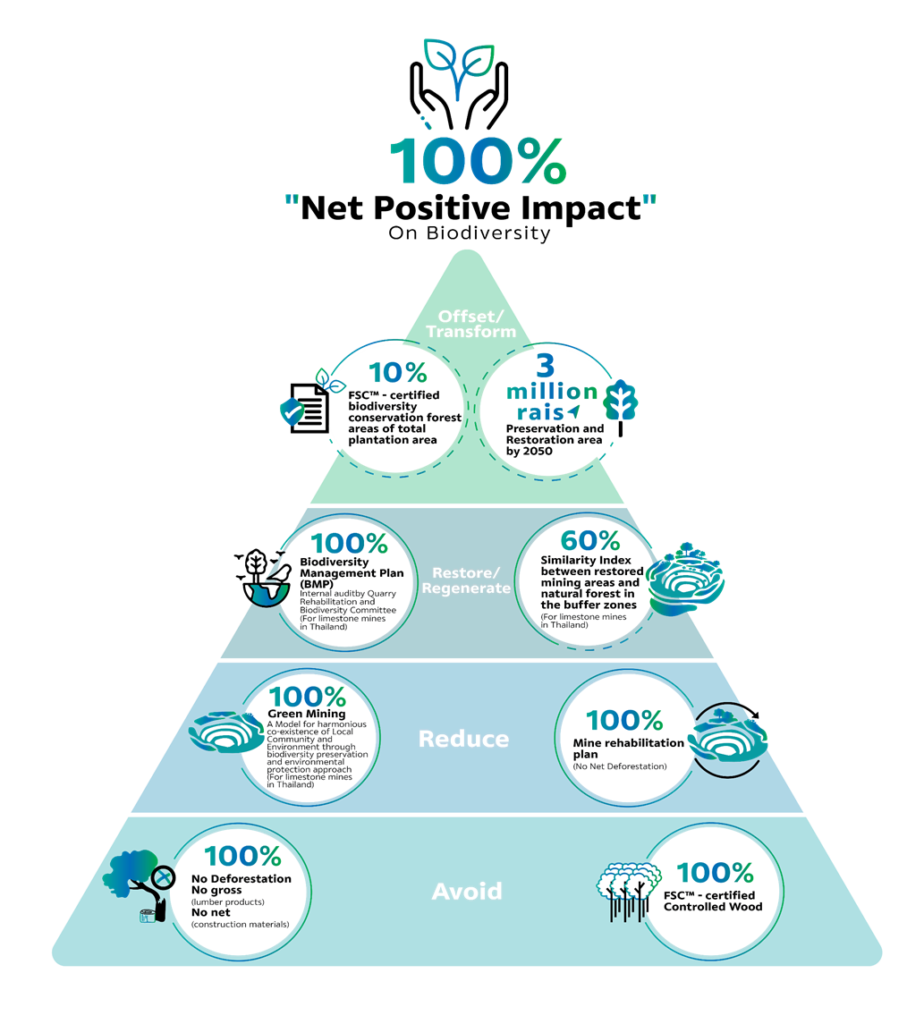
Net Positive Impact on biodiversity
- 100% No Deforestation
No gross (lumber products)
No net (construction materials) - 10% FSC™-certified biodiversity conservation forest areas of total plantation area \
- 100% FSC™-certified Controlled Wood
- 100% Mine rehabilitation plan
- 60% Similarity Index
between restored mining areas and natural forest in the buffer zones
(For limestone mines in Thailand) - 100% Biodiversity Management Plan (BMP)
Internal audit by Quarry Rehabilitation and Biodiversity Committee
(For limestone mines in Thailand) - 3 million rais Preservation and Restoration area by 2050
Target: Achieve Net Positive Impact on Biodiversity in the Pilot Area by 2030
Biodiversity Risk Assessment
Following TNFD guideline, SCG employs the LEAP approach (Locate, Evaluate, Assess, and Prepare) to systematically identify and assess nature-related issues.
 | First step, Locate – Nature mapping begins with the Locate phase, where SCG carefully examines how our activities interact with the natural world. By analyzing operations, value chains, and geographical presence, companies gain a clear picture of where and how we touch the environment. |
 | In the Evaluate – SCG takes a deeper look at our connection to nature. We measure how much we depend on natural resources and ecosystem services, while also understanding our impact on these vital systems. This creates a rich foundation of data to inform strategic decisions. |
 | For the Assess – The Assess phase transforms this knowledge into actionable insights. SCG examines potential risks to our operations from environmental changes, while also discovering opportunities to create positive impacts. This dual perspective ensures both protection against threats and pursuit of sustainable value creation. |
 | In the Prepare – SCG channels the insights into concrete action. We develop targeted strategies, create detailed roadmaps for implementation, and establish robust systems for monitoring progress. This phase also emphasizes the importance of transparent reporting to stakeholders about environmental initiatives and outcomes. |
Methodology


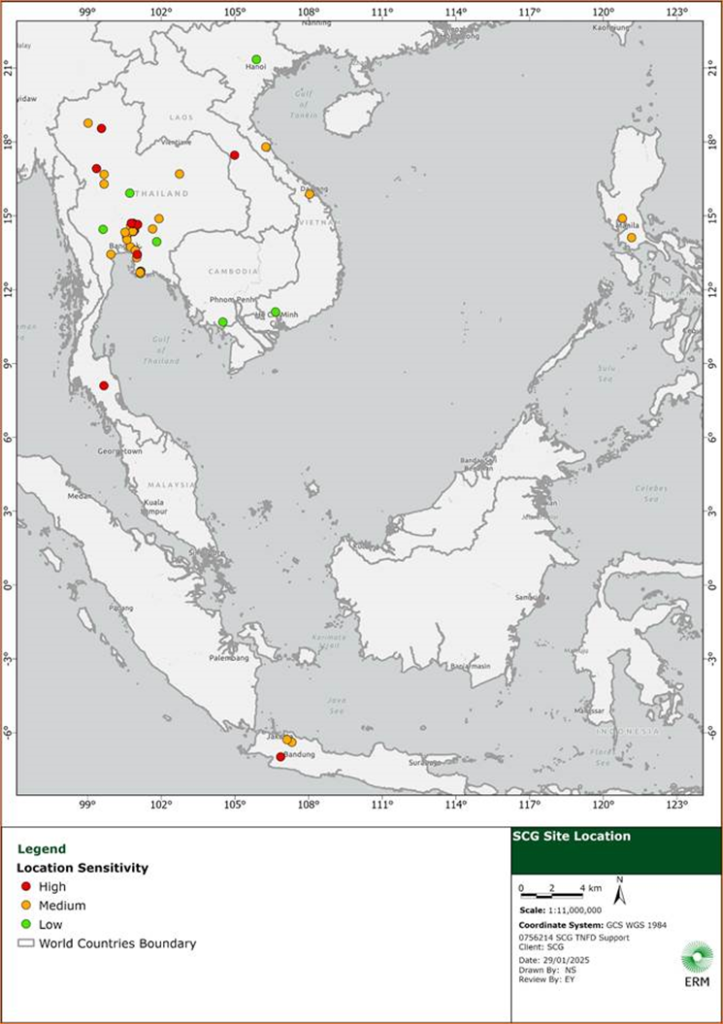
Scope of Biodiversity Risk assessment
52 sites of SCG business from 5 business units, including the value chain, are assessed for sensitive locations cover approximately 65% of total revenue in 2024. The sites are selected based on the sites’ proximity to important natural habitats, environmental footprint, impact and significance to SCG’s portfolio.
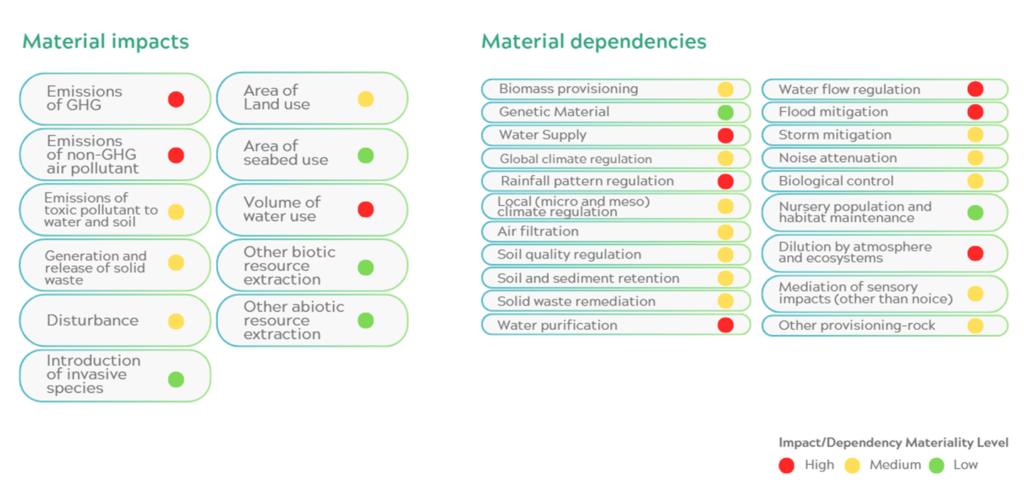
Dependency and Impact
NATURE-RELATED RISKS

A comprehensive list of nature-related physical and transition risks as well as opportunities for each of SCG’s business units has been developed based on the TNFD sector-specific guidance and an evaluation of impacts and dependencies.
WWF BRF is used to generate risk scores for each site and adjected with SCG‘s risk matrix and mitigation actions. As a result, there is no high nature-related risks with current condition.
Biodiversity Mitigation Hierarchy

AVOID
SCG commits to achieve Net Positive Impact (NPI) on biodiversity and no deforestation. This commitment is delivered through sustainable forest management in accordance with Forest Stewardship Council™ (FSC™) standards for packaging business, as well as through an innovative mine design called the “Semi-Open Cut” for cement business. This design leaves approx. 50% of the concession area along the mine boundary line as a buffer zone to maintain the visual aesthetic of the natural landscape, conserve biodiversity and ecosystem functions in the area, and serve as reference for future mine rehabilitation.
REDUCE
SCG applies “Minesight”, a mine design program, to minimize the operation area at a time, leaving some part of the operation area undisturbed until necessary, while enabling prompt rehabilitation of finished area. Also, SCG implements a range of measures to further reduce operational impacts, including enforcing speed limits, restricting blasting schedules, and using delay detonators to minimize vibration.”
RESTORE/REGENERATE
SCG have been collaborating with experts from various educational organizations to design mine rehabilitation with biodiversity conservation concept, focusing on planting local native species with 60% Similarity index and creating ecosystem services in the area as well as developing endemic species conservation program to maintain key species in the area. In addition, SCG develops rehabilitation plan and biodiversity management plan (BMP) in every site. For Packaging Business, the company conserves at least 10% of FSC™-certified land as the biodiversity conservation area. The biodiversity survey shows High Conservation Value and Diversity Index
TRANSFORM
We collaborate with Department of National Parks, Wildlife and Plant Conservation and Royal Forest Department to restore forest with biodiversity conservation concept in other areas as part of Natural CSCG collaborates with the Department of National Parks, Wildlife and Plant Conservation and the Royal Forest Department to restore forests beyond site boundaries as part of Natural Climate Solutions. SCG also works with the Department of Coastal and Marine Resources to restore mangrove forests, plant seagrass, establish fish homes and rehabilitate coral reefs through Love the sea project, using coral homes from SCG 3D printing technology designed to blend with natural environments without causing harm to marine ecosystems. To date, 3,073 coral homes have been installed in Thai seas. Biodiversity surveys at Koh Maiton and Koh Racha Yai, Phuket, revealed that three years after installation, approximately 115 healthy coral colonies (averaging 3–5 cm in size) had emerged per one coral home, alongside the presence of 48 fish species.
Collaboration with external expert advisers and subject matter experts on efforts to reduce loss of biodiversity in priority locations.

Examples of bio-diverse habitat in conservation area

Risk Monitoring and Reporting
It is essential for risk owners to continuously monitor and periodically review the identified, assessed, and managed risks. The outcome of the implementation of risk mitigation measures will be reported to various committees at different time intervals, such as the Business Unit Risk Management Committee, SCG Risk Management Committee, SCC Audit Committee, and SCC Board of Directors. For instance, medium-term risk is reported on an annual basis, while operational risk is reported on a quarterly basis
Definition
| Biodiversity | The variability among living organisms from all sources, including, inter alia, terrestrial, marine and other aquatic ecosystems and the ecological complexes of which they are part; this includes diversity within species, between species and of ecosystems. |
| Dependencies | Aspects of ecosystem services that an organization or other actor relies on to function. Dependencies include ecosystems’ ability to regulate water flow, water quality, and hazards like fires and floods; provide a suitable habitat for pollinators (who in turn provide a service directly to economies), and sequester carbon (in terrestrial, freshwater and marine realms). |
| Impacts | Changes in the state of nature, which may result in changes to the capacity of nature to provide social and economic functions. Impacts can be positive or negative. They can be the result of an organization’s or another party’s actions and can be direct, indirect or cumulative. |
| Nature | The natural world, with an emphasis on the diversity of living organisms (including people) and their interactions among themselves and with their environment. |
| Nature-related risks | Potential threats posed to an organization linked to their and wider society’s dependencies on nature and nature impacts. These can derive from physical, transition and systemic risks. |
| Rehabilitation | Measures taken to rehabilitate degraded ecosystems or restore cleared ecosystems following exposure to impacts that cannot be completely avoided and/ or minimized. Rehabilitation emphasizes the reparation of ecosystem processes, productivity and services, whereas the goals of restoration also include the re-establishment of the pre-existing biotic integrity in terms of species composition and community structure. |
| Restoration | Any intentional activities that initiates or accelerates the recovery of an ecosystem from a degraded state. |
Document Download
Quarry Rehabilitation and Biodiversity Policy
SCG BIODIVERSITY MANAGEMENT PLAN
SCG Biodiversity Exposure and Assessment
SCG Maetan Model
SCG Smart Green Mining