Risk Management

SCG has implemented its Enterprise Risk Management Framework in alignment with international standards. The framework consists of the followings:
- Strategy Establishment
SCG has established explicit objectives and risk appetite in managing risks to ensure consistent risk management practice across the organization. - SCG Risk Management Structure and Responsibilities The organizational structure of SCG’s risk management is illustrated below:

3. Risk Management Policy
SCG has implemented risk management framework in alignment with international standards and integrated it into the corporate business operations. This allows SCG to identify risks or business opportunities in an appropriate and timely manner, and to reduce the risks to an acceptable level or identify opportunities to add value to the organization in an attempt to achieve the established goals, meet the expectations of stakeholders, promote sustainable business operation, and comply with the good corporate governance principles.
4. Risk Management Process
The SCG risk management framework covers three key areas: Strategic risk, Investment risk, and Operational risks. The risk management process comprises identifying risks or opportunities, risk assessment, risk response, and risk reporting.
Additionally, SCG has established a Business Continuity Management Governance Structure to prepare for potential crises that may disrupt the company’s operations. Companies under SCG are required to analyze their business activities and resources to assess the impact of possible disruptions. SCG establishes a business continuity management system by analyzing its resources and business activities, assessing risks, preparing plans such as a risk management plan, a crisis management manual, an emergency response plan, and business continuity plan. SCG also stipulates that executives at all levels and involved employees must practice, maintain, and revise the plans and manuals constantly so they can be implemented effectively during crises.
Furthermore, SCG makes use of analytic tools such as Sensitivity Analysis, Stress Testing and Scenario Planning to assess the extent to which various factors could potentially affect the financial performance of its businesses. The evaluation is not limited to financial risks, but also included non-financial risks. SCG conducts the sensitivity analysis, for example, on changes in foreign exchange risk, key energy and raw materials price risks in its normal operation, and investment returns in the investment projects. For non-financial risks, SCG employs the stress testing and scenario planning to monitor the availability of water from the major reservoirs nearby the plants such as in Rayong Province. By leveraging the ENSO forecast model and an in-house model to analyze precipitation and estimate water inflow patterns in different scenario, the company can formulate mitigation plans and choose the appropriate actions for each scenario in a timely manner.
5. Building a Corporate Risk Culture
SCG is committed to building a strong risk culture organization-wide. SCG has, therefore, assigned top executives to communicate the significance of risk management and be role models in risk management. They are also entrusted with establishing practical guidelines on effective risk management practices and integrating them with decision-making process. Apart from that, related trainings and seminars are also provided to management and employees throughout the organization. SCG also places the importance of business management in line with an integrated GRC approach through various communication efforts.
SCG Risk Appetite Statement
“To grow its business in a profitable,
sustainable manner,
SCG will proactively manage its risks.
In doing so, SCG does not tolerate risk that endangers the health & safety of its employees, business partners, customers or the communities in which it operates; violates SCG’s environmental or compliance standards; OR that harms SCG’s reputation.
SCG will also knowingly take on risks
with financial impact in line with
prevailing corporate guidelines
(note that these may change over time).”
Key Risks, Business Opportunities, and Risk Management Strategies
In 2025, SCG conducted a risk assessment aligned with sustainability development issues, covering environmental, social, and good corporate governance risks.
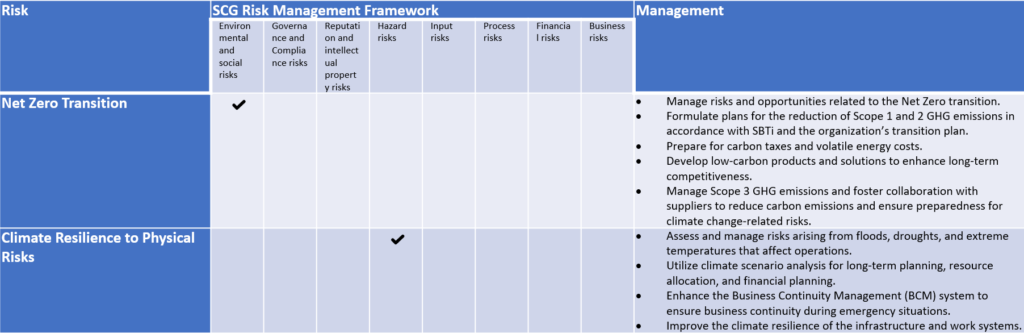
SCG evaluated business impacts through the SCG Risk Universe, which categorizes risks into 8 types:
• Environmental and social risks
• Governance and Compliance risks
• Reputation and intellectual property risks
• Hazard risks
• Input risks
• Process risks
• Financial risks
• Business risks
Key Material Risks
SCG has adopted the International Sustainability Standards Board (ISSB) framework as guidance for identifying and managing sustainability-related risks and opportunities in alignment with the organization’s risk management approach. Sustainability-related Risks and Opportunities (SROs) are integrated into Enterprise Risk Management (ERM) and linked with the Medium-Term Plan (MTP) to support the assessment and monitoring of risks that may impact business operations in the short, medium, and long term.
The assessment process begins with analyzing external context and trends, such as climate change, regulatory developments, technological changes, and stakeholder expectations, together with benchmarking against international standards and indices. Sustainability-related risks and opportunities across the value chain are then identified and assessed, considering both financial impacts as well as environmental and social impacts in accordance with relevant international frameworks.
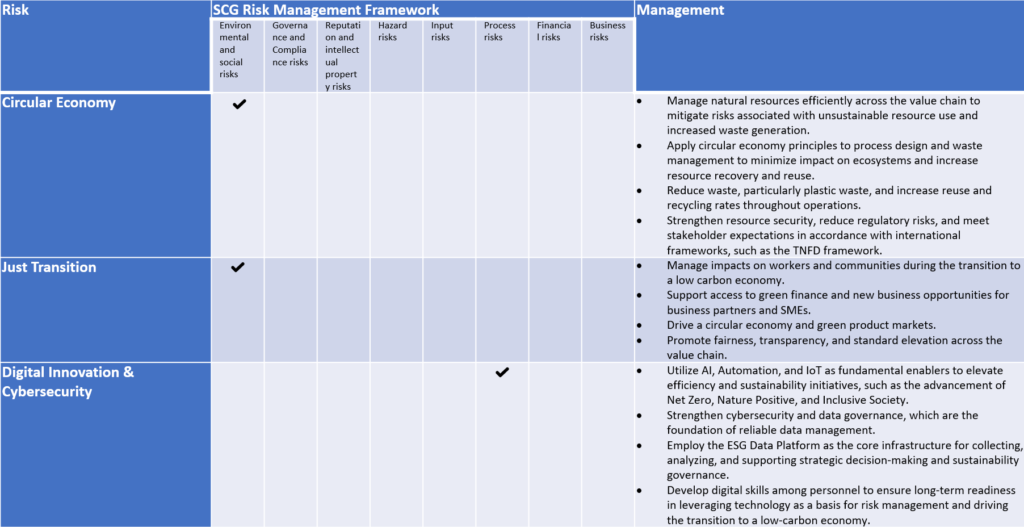
The results of the assessment are integrated into the organization’s enterprise risk management system to enable systematic monitoring and management of sustainability-related risks. Through this process, SCG has identified five key sustainability risk topics:
1. Net Zero Transition
2. Climate Resilience to Physical Risks
3. Circular Economy
4. Just Transition
5. Digital Innovation & Cybersecurity
These topics reflect significant risks that may impact SCG’s business operations across economic, environmental, and social dimensions. They are continuously monitored and managed under the organization’s risk management framework.
Key Material Risks and Management
DOCUMENT DOWNLOAD
Enterprise Risk Management Experience of SCG Non-Executive Directors
Regular Risk management Education for Non-Executive Directors