Nature Positive
With global temperatures rising steadily and the climate crisis intensifying worldwide, focusing solely on greenhouse gas (GHG) reduction is no longer enough to buffer the impacts of increasingly severe natural disasters. Mitigation must be paired with climate adaptation, alongside the minimization of impacts on natural resources, the reduction of dependency on such resources, as well as the continuous revitalization of nature. In tandem, efforts must be made to generate economic and social value in a balanced manner and support net-zero goals by enhancing natural carbon sinks, reducing resource risks across the value chain, and driving a systematic and sustainable transition to a low-carbon economy through a circular economy-driven approach.
Given the global mission to halt nature loss by 2030 and achieve full ecosystem recovery by 2050, SCG recognizes the vital importance of natural resources and has adopted the Global Biodiversity Framework (GBF) and the Taskforce on Nature-related Financial Disclosures (TNFD), specifically the LEAP approach (Locate–Evaluate–Assess–Prepare), as its primary tools for assessing its dependencies and impacts on nature. These tools are also deployed for the management and disclosure of data, with material dimensions consisting of water management, circular resource use, biodiversity, and air quality across key areas of the value chain. This is achieved through public–private–people partnership (PPPP) in collaboration with the government, private sector, academic institutions, and local communities.
Regarding water management, SCG prioritizes water efficiency, recycling, and returning high-quality water to the ecosystem. In parallel, SCG seeks to restore and secure water resources for both its operations and surrounding communities to maintain balance and mitigate the risk of water scarcity in the long term.
In terms of circular economy and waste management, SCG is reducing its reliance on virgin resources by increasing the ratio of recycled materials in its products and enhancing resource efficiency by reducing waste at the source and promoting systematic reuse to create long-term value.
As for biodiversity, SCG strives to achieve a net-positive impact on biodiversity across its pilot areas, enhancing ecosystem health both within its operating sites and throughout the value chain.
Finally, regarding air quality, SCG has deployed technologies to reduce and control emissions. In tandem, SCG continuously monitors, evaluates, and improves air quality across its sites while also collaborating with communities and stakeholders to manage air quality issues systematically and sustainably.
Operational Strategies
| Strategy | Key Actions |
| 1) Sustainable Water Management | • Improve water efficiency within production processes. • Scale up the use of recycled water and closed-loop water systems. • Restore water quality and return it to nature and communities in better condition and larger quantities than when it was withdrawn. • Collaborate with communities in high-risk areas to strengthen water stewardship and ensure business continuity. |
| 2) Circular Economy and Waste Management | • Design products and processes to eliminate material waste at the source. • Increase the proportion of recycled materials and alternative raw materials with low ecosystem impact. • Utilize waste as raw materials or alternative fuels through industrial symbiosis. • Collaborate on the development of closed-loop mechanical and chemical recycling systems. • Develop eco-friendly products and solutions across their entire life cycle. |
| 3) Impact Mitigation and Restoration of Biodiversity | • Apply the mitigation hierarchy (avoid – minimize – restore – offset) to manage impacts on biodiversity. • Develop environmentally responsible production processes, including sustainable forest management aligned with FSCTM- Forest Stewardship CouncilTM Standards, the development of semi-open cut mining practices, and the implementation of mine rehabilitation plans and biodiversity management plans. • Conserve and restore terrestrial and marine ecosystems through initiatives such as reforestation, check dam construction, mangrove restoration, and coral reef rehabilitation, in partnership with experts and relevant agencies. |
| 4) Air Quality Management | • Reduce dust emissions released into the environment. • Build partnerships with communities and stakeholders to mitigate air quality impacts. |
Outcomes
1. Sustainable Water Management
Recognizing the immense value of water, SCG has elevated its management approach by focusing on community collaboration, watershed-level ecosystem conservation, and sustainable water security through several key initiatives.
Technology Deployment to Enhance Water Efficiency and Water Recycling
In 2025, a key initiative was the expansion of the chloride concentration limit in the cooling water recirculation system at Map Ta Phut Olefins Co., Ltd. This project reduced external water withdrawal by more than 250,000 cubic meters, with an estimated annual reduction of up to 400,000 cubic meters when operated for a full year. In terms of investment, SCGC advances eco-efficiency through improvements to cooling systems, increased water recirculation, and investments in advanced technologies such as Reverse Osmosis (RO) and recycled water treatment systems. These efforts enhance operational efficiency, reduce energy consumption, and deliver sustainable outcomes. SCGC also collaborates with global partners such as Ecolab to integrate advanced technologies and expertise into its production processes. This partnership strengthens water-use efficiency, reduces water-related risks, and enhances resilience against resource uncertainties. As a result, in 2025, SCGC reduced freshwater withdrawal from natural sources by more than 300,000 cubic meters.
SCG places strong emphasis on systematic water resource management amid increasing drought risks driven by climate change and evolving government water management policies, which may affect production costs and community relations particularly in key industrial zones such as Thailand’s Eastern region.
The Company has integrated the TNFD LEAP approach into its enterprise risk management processes to assess and manage water-related risks and opportunities. This approach aims to reduce dependency on natural water resources, minimize impacts on ecosystems, and strengthen long-term business resilience. These efforts are implemented alongside water efficiency improvements, increased water recycling, watershed restoration, and support for community access to clean water, under the principle that water is a shared resource.
SCG remains committed to becoming a Water Positive organization by maximizing water-use efficiency and returning more water to nature and ecosystems than is withdrawn.
Collaboration for EEC Security
In the Eastern Economic Corridor (EEC), SCG has expanded its role from internal water management to creating tangible regional value. Through a partnership with the public and private sectors and local communities, SCG has established the Keyman Water War Room (Eastern) to oversee water management in Chachoengsao, Chonburi, and Rayong. A primary measure involved pre-emptive water diversion through the Eastern Water Grid to fill reservoirs ahead of the 2026 dry season, resulting in several reservoirs reaching near-full capacity and ensuring sufficient water supply for both industry and local communities. Additionally, SCG plays a proactive role in the East Coast Basin Committee to help define the long-term direction of regional water management by sharing data, technology, and internal management expertise to sustainably bolster water security.
Developing a Community Water Management Prototype
Beyond industrial operations, SCG has scaled its efforts to the community level through a sustainable community water management project in Saraburi, specifically in Muak Lek and Kaeng Khoi Districts. In collaboration with the Hydro-Informatics Institute (HII) and government agencies, SCG utilized scientific data to analyze high-risk areas and invited residents to participate in creating community water maps to identify local issues and plan for efficient water storage and distribution. The result has not only increased water security but also built community self-resilience and climate readiness in accordance with the Sufficiency Economy Philosophy, which emphasizes the reasoned and valuable use of resources.
2. Circular Economy and Waste Management
SCG advances the circular economy through its core businesses, SCGC and SCGP, by integrating resource efficiency, system-based design, and waste management throughout the value chain. This approach strengthens long-term competitiveness, mitigates risks associated with raw material price volatility, and enhances preparedness for increasingly stringent environmental regulations in global markets. SCGC has established a strategic target to circulate 500,000 tons of post-consumer plastic waste into the production cycle annually by 2030 as value-added raw materials, supporting the transition toward more resource-efficient production and consumption. In 2025, the Company circulated 193,069 tons of post-consumer plastic waste. At the same time, SCGP has enhanced packaging design through customer co-creation to improve material circularity and reduce end-of-life impacts. The Company has committed that 100% of its packaging will be reusable, recyclable, or compostable by 2030, with current achievement at 99.7%. These initiatives reflect clear target-setting, quantitative performance tracking, and the integration of environmental outcomes with long-term business resilience.
3. Impact Mitigation and Restoration of Biodiversity
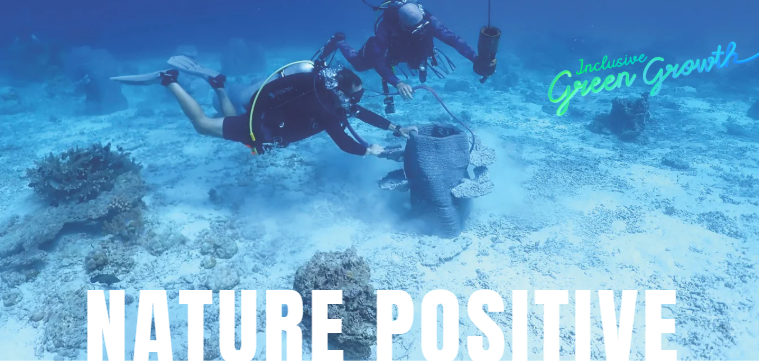
SCG has implemented biodiversity management plans covering 100% of its limestone mines in Thailand. Regarding the use of products from commercial plantations, FSC™ (Forest Stewardship Council™) standards have been fully adopted as the operational framework, covering 100% of relevant operations. At least 10% of FSC™-certified plantation areas are designated as conservation zones to protect biodiversity and ecosystems. In parallel, SCG supports community forest conservation to continuously restore natural abundance and increase the carbon sequestration capacity. Furthermore, SCG has expanded its restoration efforts to marine and coastal ecosystems through the Love the Sea Project. By using SCG 3D printing technology to create coral larvae settlement structures (coral homes), SCG is helping to restore coral reefs and bolster the economic stability of coastal communities.
4. Air Quality Management
SCG continuously manages air quality while fostering collaboration with external agencies, local communities, and stakeholders to address area-based particulate matter issues in a systematic manner through initiatives such as the rice straw burning reduction project in Lampang Province and the sustainable sugarcane leaf burning reduction project in Ban Pong District, Ratchaburi Province, which has been further expanded to Wang Muang District, Saraburi Province. These efforts include supporting shredding and baling machinery to convert agricultural residues into alternative fuels for industrial use. This approach contributes to reducing PM2.5 emissions, mitigating health and air quality impacts on surrounding communities, and generating tangible income opportunities for local farmers.